What would happen if the Sun disappeared?
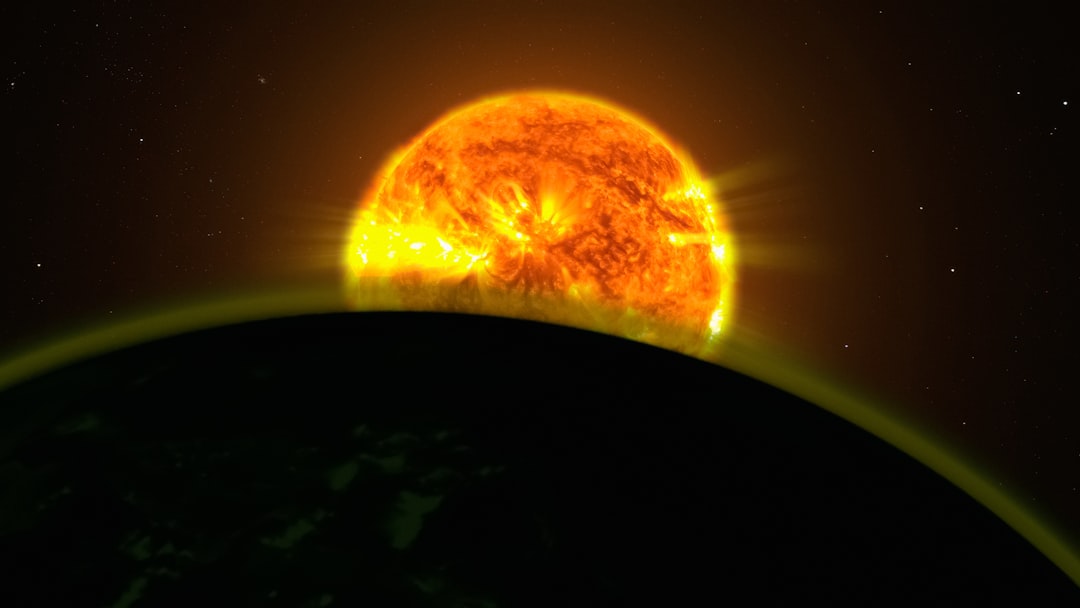
If the Sun vanished, Earth would keep orbiting for 8 minutes and 20 seconds. That delay reveals a fundamental truth: gravity and light travel at the same speed.
Imagine the Sun vanishes. One moment it's there, blazing in the sky. The next, it's gone. What happens to Earth? The answer is not instantaneous, and it tells you something profound about the universe.
For eight minutes and twenty seconds after the Sun disappears, Earth would keep orbiting as if nothing had changed. The planet would trace its familiar path around an empty point in space. Then, in a single instant, two things would happen: the sky would go dark, and Earth would fly off in a straight line into interstellar space.
That eight-minute, twenty-second delay is the time it takes for both light and gravity to travel from the Sun to Earth. The fact that they arrive at exactly the same moment is not a coincidence. It's experimental proof that gravity and light propagate at the same speed. That equality has been confirmed down to a precision of one part in a quadrillion by the detection of gravitational waves.
The eight-minute buffer
The Sun is about 93 million miles (150 million kilometers) from Earth. Light from the Sun takes about eight minutes and twenty seconds to cross that distance. But gravity also takes time to propagate. When you feel the Sun's pull on Earth, you are feeling the gravitational field that the Sun emitted eight minutes and twenty seconds ago. If the Sun were to disappear right now, the gravitational information that the Sun is gone would travel outward at the speed of light. Earth, sitting 93 million miles away, would not receive that information until those eight-plus minutes had passed.
During that brief window, Earth would continue orbiting the empty center of the former Sun's gravitational field. From our perspective, the Sun would still be visible (its last photons still en route) and the planet would feel no change in its motion. When the wavefront of missing mass finally reaches Earth, two signals arrive simultaneously: the last photons from the Sun and the change in gravity. We would see darkness and feel the loss of orbital constraint at the same moment.
What happens next
Once the Sun's gravity stops affecting Earth, the planet will leave its orbit and travel in a straight line. That line is tangent to the former orbit, so Earth would head off into deep space at about 18.5 miles per second (30 kilometers per second). Without the Sun's warmth, the surface temperature would plummet. Within a week, average temperatures would drop below freezing. Within a year, the surface would be around -240 degrees Fahrenheit (-150 degrees Celsius), cold enough to freeze the atmosphere solid. The oceans would freeze over, and any life not sheltered by geothermal vents would die.
The Moon would follow a similar fate, released from Earth's gravity to drift alongside it. The entire solar system would unravel as each planet, asteroid, and comet finds itself suddenly free of the Sun's influence, each flying off on its own straight path.
The deeper revelation: gravity speed equals light speed
That eight-minute-twenty-second delay is not just a fun fact. It is a direct measurement of the speed of gravity, and that measurement matches the speed of light. Albert Einstein's general theory of relativity predicted this equality. Gravitational waves, which are ripples in spacetime itself, were predicted to travel at the speed of light. But it wasn't until 2015, when the LIGO experiment detected the first gravitational wave, that scientists could test that prediction directly.
When LIGO observed the merger of two black holes 1.3 billion light-years away, the gravitational wave signal arrived at Earth at the same time, within very tight bounds, as the electromagnetic waves from the same event. That event, GW170817 (a neutron star merger), provided the strongest constraint: gravity and light speeds differ by less than one part in 10^15—literally a quadrillionth of a percent.
Gravitational waves: the messengers
Gravitational waves are created by violent cosmic events: merging black holes, colliding neutron stars, even the Big Bang itself. They stretch and squeeze space as they pass. A passing wave will minutely alter the distance between objects on Earth. That is how LIGO detects them: by measuring changes in the length of its two 4-kilometer arms that are smaller than a proton's width.
These waves carry information that light cannot. Light is scattered by matter; gravitational waves pass through everything almost unaffected. That means they can carry signals from the hearts of supernovae or from the first seconds after the Big Bang, places opaque to ordinary light.
What this means for physics
The equality of gravity's speed and light's speed is a cornerstone of relativity. If they were different, much of modern physics would need to be rewritten. The fact that they match so precisely means that theories proposing exotic modifications to gravity or extra dimensions must pass an extremely tight constraint. It also rules out many alternative theories of gravity that predicted a slight difference.
For the average person, the eight-minute-twenty-second delay is a reminder that the universe has a speed limit. You cannot transmit information—whether it's a TV signal or a gravitational tug—faster than light. The Sun's disappearance would give humanity an eight-minute warning, a final window of normalcy before darkness and silence set in. During that window, you could look up at a Sun that no longer existed and know that what you are seeing is a ghost.
Practical takeaways
The Sun is not going to disappear. It will burn for another 5 billion years before turning into a red giant and then a white dwarf. But the thought experiment is useful because it forces you to confront the nature of time, information, and causality in the universe.
When you look at the Sun, you see it as it was 8 minutes and 20 seconds ago. When you feel its gravity, you feel the same delay. The two signals are locked together, inseparable, because they are manifestations of the same underlying structure of spacetime.
Gravitational wave astronomy is now opening a new window on that structure. With each detection, we refine our understanding of how gravity propagates. The precision of that measurement—one part in 10^15—is a testament to the power of observation and the ingenuity of the experiments built to test our theories.
So if the Sun ever did vanish, you would have a few minutes to marvel at the symmetry of physics before the world went dark. And then you would be riding a cold, dark rock through an infinite night.
But you'd know this: the light and the gravity left together, and that tells you everything about how the universe works.
Staff Writer
Emily covers space exploration, physics, and scientific research. Holds a degree in astrophysics.
Comments
Loading comments…


