Proxima b: Exploring the Closest Potentially Habitable Exoplanet
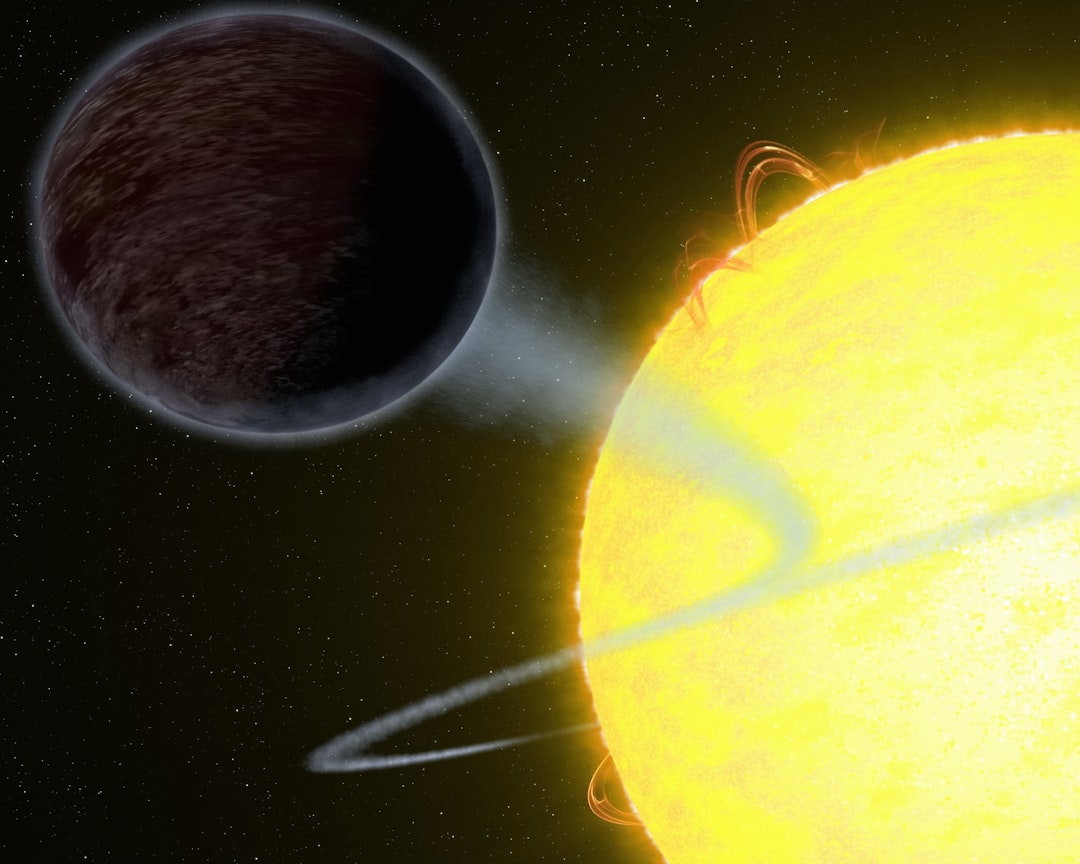
Proxima b, orbiting the red dwarf Proxima Centauri just 4.24 light years from Earth, is the closest exoplanet in the habitable zone. Could life exist there?
Proxima b: Is Earth’s Closest Exoplanet Habitable?
Proxima b, a rocky exoplanet orbiting the red dwarf star Proxima Centauri, lies just 4.24 light years away from Earth. This makes it the closest potentially habitable world ever discovered outside our solar system. Its location within the habitable zone, where liquid water might exist, has sparked global scientific interest. Could Proxima b sustain life? Or is this Earth-like planet uninhabitable due to its harsh environment and the immense technological barriers to reaching it?
Physical Characteristics of Proxima b
With a radius estimated at 1.17 times that of Earth and gravity about 1.3 times stronger, Proxima b bears an uncanny resemblance to our own planet. Its gravity would likely allow liquid water to persist on its surface, if water exists in sufficient quantities. This similarity raises hopes for the planet’s potential to support life. Yet, Proxima b’s habitability depends not only on its size and gravitational pull but also on its star and atmospheric conditions.
The Host Star: Proxima Centauri
Proxima Centauri, the red dwarf star around which Proxima b orbits, presents significant challenges. Unlike our stable Sun, red dwarfs are notorious for their periodic stellar flares. These flares release bursts of ultraviolet and X-ray radiation hundreds of times stronger than any solar storm we experience on Earth. While red dwarfs are stable over trillions of years, their short-term volatility could prove catastrophic for planetary atmospheres and surface life.
Even more problematic is the planet’s proximity to its star. To stay within the habitable zone, Proxima b orbits much closer to Proxima Centauri than Earth does to the Sun. This close orbit likely results in tidal locking—where one side of the planet experiences perpetual daylight, while the other remains in eternal darkness.
Tidal Locking and Atmospheric Challenges
The tidal locking of Proxima b complicates its habitability. The daylight side could be scorched by constant heat, while the night side could freeze without sunlight. For life to thrive, the planet’s atmosphere must redistribute heat between these extremes effectively. However, intense radiation from Proxima Centauri could gradually strip away Proxima b’s atmosphere, particularly its lighter gases like hydrogen and helium. This would leave the surface exposed to harmful radiation unless the planet possesses a magnetic field strong enough to shield it—similar to Earth’s magnetosphere.
Could Proxima b Support Life?
The presence of life on Proxima b depends on its atmosphere’s stability, composition, and ability to protect against radiation. If the atmosphere is thick enough, it could potentially regulate temperature variations and shield the planet from harmful flares. Alternatively, life could exist below the surface or in oceans, shielded from radiation.
Astronomers are eagerly awaiting data from next-generation telescopes capable of studying Proxima b’s atmosphere, searching for signs of oxygen, water vapor, or other life-supporting compounds. Until more information is available, the possibility of life on Proxima b remains speculative.
The Challenge of Distance: 4.24 Light Years
Proxima b may be close in astronomical terms, but the distance of 4.24 light years translates to over 40 trillion kilometers. This is 250,000 times farther than the distance between Earth and the Sun. With current spacecraft technology, the journey would take an incomprehensible 76,000 years. Voyager 1, the fastest human-made object, travels at 17 kilometers per second, a fraction of the speed needed for interstellar travel.
Overcoming Technological Barriers
The Starshot Project
The Breakthrough Starshot initiative proposes a novel solution through light sail technology. Tiny micro-spacecraft equipped with ultra-thin light sails could be propelled by ground-based lasers to 20% the speed of light, cutting the journey to Proxima b to 20–30 years. While promising, Starshot faces considerable hurdles:
- Durability: Light sails must withstand extreme radiation, heat, and high-speed collisions with micro-debris.
- Precision: Directing a laser onto a small sail millions of kilometers away requires unprecedented accuracy.
- Energy Requirements: Operating a laser array capable of delivering 100 gigawatts of power requires revolutionary advancements in energy generation.
The Physics of Interstellar Travel
Chemical propulsion, the technology behind all current rockets, is wholly inadequate for interstellar distances. The constraints of the Tsiolkovsky rocket equation reveal that carrying enough fuel for near-light speed travel is practically impossible. The only viable options involve entirely new methods of propulsion, such as antimatter engines or harnessing electromagnetic forces.
Human Barriers: Health, Psychology, and Sustainability
Even if interstellar transportation becomes feasible, significant challenges remain for human survival during a centuries-long voyage. Microgravity weakens muscles and bones, disrupts organ function, and affects the cardiovascular system. Astronauts lose up to 3% of bone mass per month in microgravity, leading to osteoporosis and increased risks of fractures.
Furthermore, the psychological toll of deep-space isolation cannot be understated. NASA’s Mars 500 experiment revealed heightened stress and mental health challenges after enduring a Mars mission simulation for just 520 days. A journey to Proxima b would demand advances in both physical and mental health support for the crew.
Sustainability is another hurdle. Long-term voyages require closed-loop life support systems. Technologies like those on the International Space Station (recycling water and producing oxygen) are a start, but feeding a crew over decades requires more complex systems, such as onboard farming or bioreactors.
The Road Ahead
While Proxima b ignites the imagination as a potential second Earth, it also highlights the vastness of interstellar travel’s obstacles. Its environmental conditions remain uncertain, and current propulsion technologies make reaching it within a human lifetime implausible. Projects like Breakthrough Starshot are critical steps toward addressing these challenges, but humanity is still in the infancy of interstellar exploration.
As astronomers refine their tools and engineers push the boundaries of propulsion and sustainability, Proxima b reminds us of both our limitations and ambitions. For now, it serves as a powerful symbol of humanity's quest to understand the universe and our place within it.
FAQ
Why is Proxima b considered potentially habitable?
Proxima b lies within the habitable zone of its star, where liquid water could exist. Its size and gravity are similar to Earth’s, which might support familiar life structures.
What makes red dwarfs like Proxima Centauri problematic for habitability?
Red dwarfs are highly active stars with frequent stellar flares that emit harmful radiation. This can strip away a planet’s atmosphere, making surface conditions hostile.
How long would it take to travel to Proxima b?
Using current spacecraft technology, it would take around 76,000 years. New proposals like the Starshot Project aim to reduce this to 20–30 years using light sail technology.
What is tidal locking, and how does it affect Proxima b?
Tidal locking is when one side of a planet always faces its star, resulting in extreme temperature differences between the day and night sides. This could challenge the planet’s ability to support life unless heat can be evenly distributed.
What are the biggest challenges to interstellar travel?
Key challenges include the lack of propulsion capable of near-light-speed travel, the physiological effects of microgravity, sustainable life support systems, and overcoming cosmic radiation hazards.
Staff Writer
Daniel reports on biology, climate science, and medical research.
Comments
Loading comments…


